
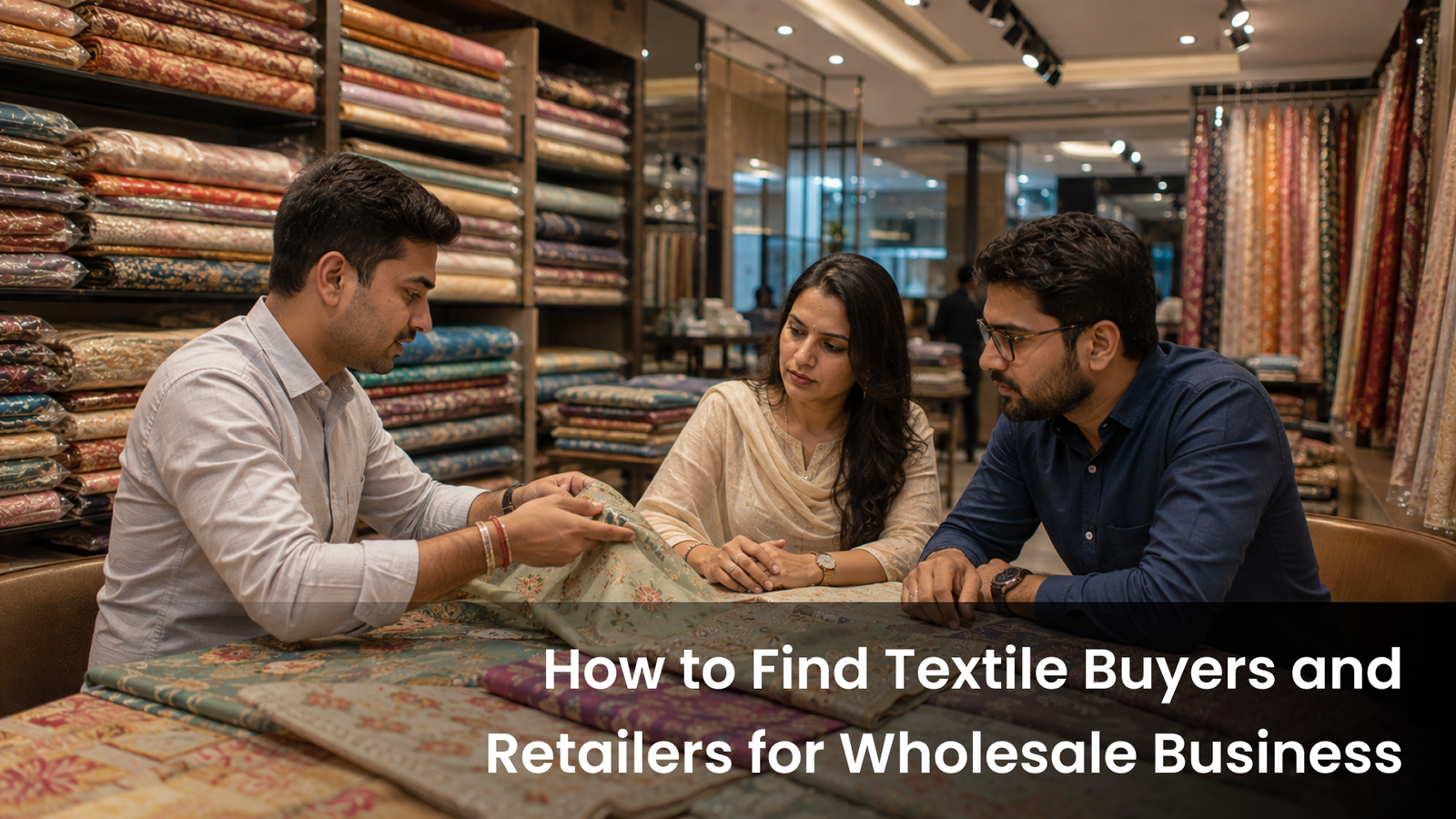
Finding textile buyers for wholesale business is one of the biggest challenges for a new wholesaler. Having good products is only half of the business. The other half is consistently getting those products in front of retailers who are actually willing to buy them.
Many textile wholesalers start by sending product photos to everyone they know. After a few days, the response slows down. Messages get ignored, retailers ask for prices without ordering, and the wholesaler starts believing that there is no demand.
Usually, the problem isn’t simply a lack of buyers. It is the lack of a repeatable buyer acquisition system.
Here are practical ways to build one.
1. First Define Your Ideal Buyer for Wholesale Business
Don’t start by asking: “Where can I find buyers?”
Start with: “Which buyer is most likely to buy my products?”
For example, a saree wholesaler could target:
- Saree retailers
- Boutique owners
- Multi-brand stores
- Instagram sellers
- Home-based resellers
- Regional distributors
A dress-material wholesaler may have a different buyer profile.
The more specific you are, the easier your marketing becomes.
2. Start With Your Existing Network
Your first customers may not come from Google or advertising.
Look at:
- Friends in business
- Family contacts
- Existing retailers
- Transport contacts
- Local traders
- Previous customers
- Suppliers
- Industry contacts
Ask for introductions.
A simple referral can sometimes produce a better buyer than a cold advertisement because there is already some trust.
3. Visit Retail Markets
If you are selling wholesale, spend time where your buyers actually operate.
Visit:
- Local textile markets
- Saree markets
- Boutique clusters
- Garment markets
- Fashion retail areas
- Regional wholesale markets
Don’t approach every shop with the same pitch.
Observe first.
What products are displayed?
What price range dominates?
Are customers buying traditional or modern products?
Which designs appear repeatedly?
This information can improve your collection before you even make your first sales pitch.
4. Build a Retailer Database
This is one of the most useful things a growing wholesaler can do.
Create a basic database with:
| Information | Example |
|---|---|
| Retailer Name | Sharma Sarees |
| City | Jaipur |
| Category | Sarees |
| Phone | Business number |
| @example | |
| Products Interested In | Festive Sarees |
| Last Enquiry | 10 August |
| Last Order | 5 August |
| Follow-up | 20 August |
You don’t need complicated CRM software on day one.
The important thing is that customer information shouldn’t exist only inside someone’s WhatsApp chat history.
5. Use Instagram to Find Retailers
Instagram isn’t only for consumer brands.
Search for:
- Saree stores
- Boutique owners
- Textile retailers
- Ethnic wear stores
- Fashion resellers
- Clothing businesses
Look at their profile before contacting them.
If they sell products similar to your collection, they may be relevant.
Don’t send a generic: “Wholesale available. DM me.”
Instead, make your message relevant.
For example: “Hi, we supply wholesale festive saree collections from Surat. I came across your store and noticed you focus on ethnic wear. We have a new collection in a similar price range. Would you like me to share the catalogue?”
Short. Specific. Relevant.
6. Use WhatsApp as a Follow-Up Tool
WhatsApp works well when used after you have established some context.
You can send:
- New collection alerts
- Price updates
- Seasonal collections
- Restocked products
- Special buyer offers
But don’t turn your customer list into a daily broadcast audience.
If a retailer receives 20 irrelevant messages from you, they may mute or block your number.
Segment your contacts.
For example:
Segment A: Saree retailers
Segment B: Boutique owners
Segment C: Premium buyers
Segment D: Budget retailers
Send each group relevant collections.
7. Make Your Catalogue Easy to Share
A buyer may ask: “What collection do you have?”
If your response requires sending 150 images one by one, the conversation becomes difficult.
A digital catalogue solves this communication problem.
Instead of multiple files, you can share one collection page.
CatalogDost is built specifically for this type of workflow, allowing wholesalers to organize collections into a shareable digital catalogue. CatalogDost
The objective is simple:
Buyer asks → You send one link → Buyer browses → Buyer enquires.
8. Find Buyers Through B2B Communities
Depending on your category, you can explore:
- Industry groups
- Business associations
- Facebook groups
- WhatsApp business networks
- Trade communities
- Local trader groups
- Exhibitions
However, don’t treat communities purely as advertising channels.
First understand the rules.
Then contribute useful information.
A wholesaler who becomes known as someone who understands products, pricing and the market can build more trust than someone who posts promotional messages ten times a day.
9. Use Referrals
Ask your existing retailers: “If you know another retailer who deals in this category, we’d be happy to share our latest collection with them.”
You can also create a formal referral incentive if your margins allow it.
But make the process easy.
Your existing buyer should be able to forward:
Your catalogue link + your contact details.
10. Attend Trade Events
Trade exhibitions and textile industry events can compress months of networking into a few days.
But don’t attend only to collect visiting cards.
Before an event:
- Prepare your catalogue.
- Prepare your product range.
- Define your target buyer.
- Prepare a simple introduction.
- Have your contact information ready.
After the event:
- Categorize contacts.
- Send relevant collections.
- Record conversations.
- Follow up.
The follow-up is often more important than collecting the contact.
11. Use Google Business Profile for Local Visibility
If you operate from a physical location and are eligible, your business should have an accurate Google Business Profile.
Keep:
- Business name
- Address
- Phone
- Website
- Business category
- Photos
- Opening hours
updated.
A retailer searching for a textile wholesaler in your city may discover your business without you directly contacting them.
12. Build a Simple Buyer Funnel
Instead of randomly contacting people, think in stages:
Prospect
↓
Interested
↓
Catalogue Viewed
↓
Product Enquiry
↓
Quotation
↓
Order
↓
Repeat Order
Your job is to improve the conversion between each stage.
For example, if 100 retailers view your collection but only 2 enquire, perhaps your catalogue, pricing or product selection needs improvement.
If 20 enquire but only 2 order, your sales process may need attention.
13. Follow Up Without Being Pushy
A follow-up should provide a reason.
Bad: “Sir order?”
Better: “Hi Rahul, the festive collection I shared last week has two new designs in the same price range. Sharing the updated catalogue in case you’re currently planning your next purchase.”
The second message gives the retailer something useful.
14. Don't Chase Every Buyer
Not every enquiry is a good customer.
Look for:
- Relevant product category
- Appropriate order size
- Reasonable payment behaviour
- Repeat potential
- Geographic fit
- Communication quality
A buyer who orders once and constantly negotiates every ₹5 may not necessarily be more valuable than a buyer who orders consistently.
15. Measure Your Buyer Acquisition
Track:
- Number of new prospects
- Number contacted
- Number responding
- Catalogue views
- Enquiries
- Orders
- Repeat orders
- Average order value
This helps identify which acquisition channel actually works.
Suppose:
Instagram → 50 prospects → 8 enquiries → 3 orders
Market visits → 30 prospects → 12 enquiries → 7 orders
Then market visits may be more valuable even though they generate fewer leads.
16. Build a Buyer Database Before You Need It
A common mistake is starting customer tracking only after the business becomes large.
Do it from the beginning.
Your database becomes a business asset.
Over time, you’ll know:
- Who buys what
- Who buys frequently
- Who buys seasonally
- Who prefers premium products
- Who responds to new collections
- Who has stopped ordering
That information makes your sales team much more effective.
17. The Long-Term Strategy
The best source of textile buyers isn’t always a single channel.
Build several:
Offline networking
Instagram
WhatsApp
Referrals
Search
Digital catalogue
Repeat customers
That’s a much stronger system than depending entirely on one source.
Final Thoughts
Finding textile buyers is not about sending your collection to as many people as possible.
It is about finding the right retailers, understanding what they need, presenting relevant products professionally and following up consistently.
Start with a small buyer list. Keep proper records. Learn which products generate actual orders. Then gradually expand.
And when buyers ask to see your collection, give them a simple way to browse it instead of flooding their WhatsApp with images.
Visit Related Content : How to Start a Textile Wholesale Business in India